



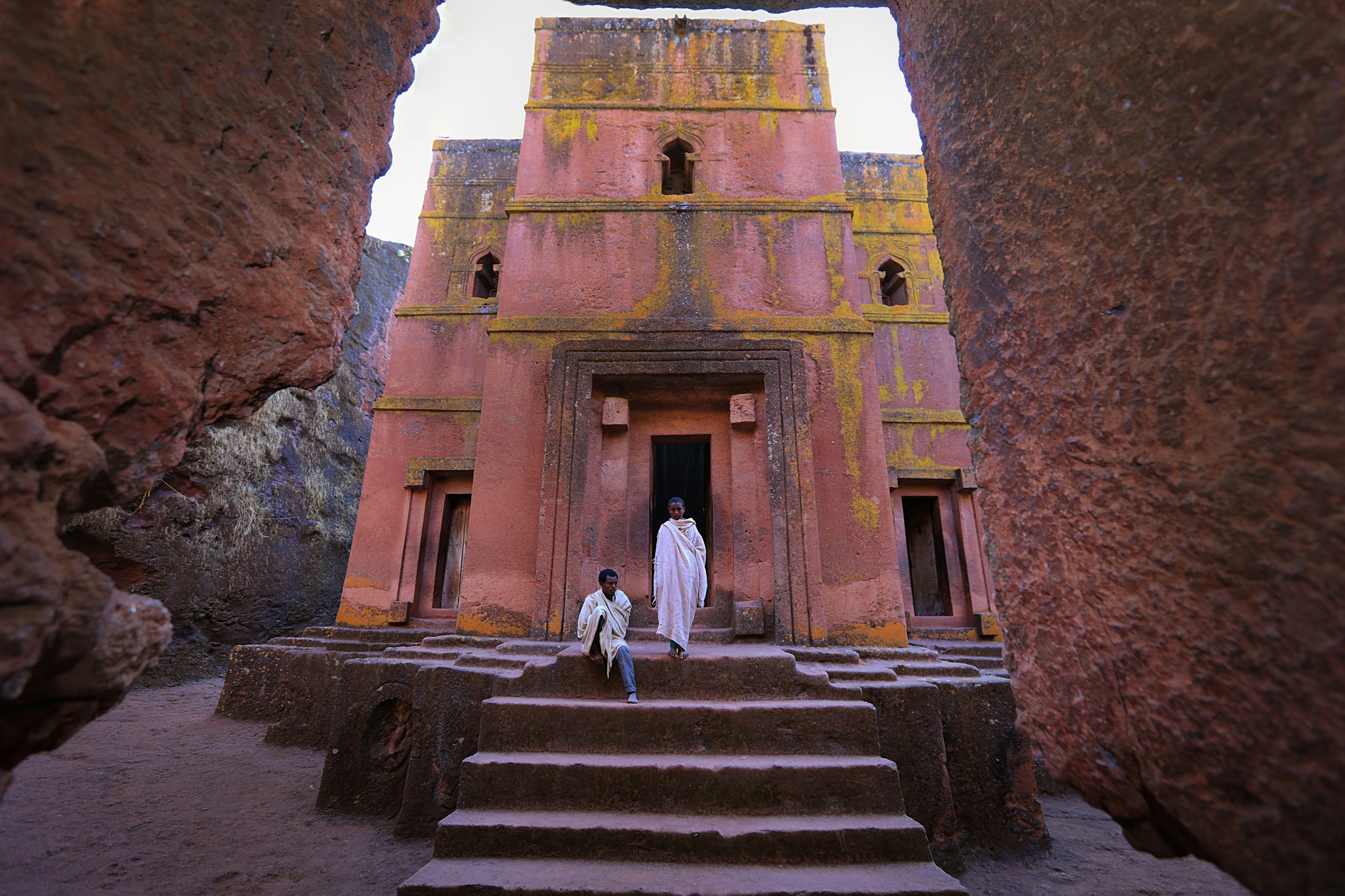
The Rock-Hewn Churches of Lalibela are among the greatest architectural and religious achievements of medieval Africa — a complex of 11 monolithic churches carved directly downward into living volcanic rock in the highlands of northern Ethiopia. They are still active places of worship today and are considered one of the holiest sites of the Ethiopian Orthodox Tewahedo Church.
Located in the town of Lalibela, historically known as Roha, the churches were inscribed as a UNESCO World Heritage Site in 1978.
What Makes Lalibela Extraordinary
Most churches are built upward by stacking materials. Lalibela’s churches were made the opposite way: workers cut downward into the rock, removing thousands of tons of stone until entire buildings emerged from the ground. The builders carved walls, roofs, windows, doors, columns, floors, drainage systems, ceremonial tunnels, and courtyards — all from a single massive block of volcanic rock. They are not simply caves — they are fully designed churches hidden in the earth.
History: Who Built Them?
The churches are traditionally attributed to King Gebre Mesqel Lalibela of the Zagwe dynasty, who ruled Ethiopia roughly from 1181–1221 CE. According to Ethiopian tradition, Lalibela wanted to create a “New Jerusalem” in Ethiopia. At the time, Christian pilgrimage to Jerusalem had become more difficult because of political changes in the Middle East. He created a sacred city where Ethiopian Christians could experience a symbolic Holy Land without leaving Africa.
The historical reality is more complex: scholars debate the exact sequence of construction, and some churches may have evolved through multiple phases rather than being completed in one single campaign. Some of the earliest rock-hewn features may date back to the 7th or 8th centuries.
Ethiopian tradition also holds that angels assisted in building the churches, working alongside human laborers at night to speed construction — a story that speaks to how astonishing the achievement seemed even to those who witnessed it.
The 11 Churches
The churches are arranged in two main clusters separated by the symbolic River Jordan — a carved channel representing the biblical river.
Northern Group
- Biete Medhane Alem (House of the Saviour of the World): Often considered the largest of the Lalibela churches. It resembles a huge classical basilica with five aisles and massive carved columns. It may be the largest monolithic church in the world.
- Biete Maryam (House of Mary): One of the most richly decorated churches, featuring painted interiors, carved crosses, and symbolic biblical imagery.
- Biete Maskal (House of the Cross): A smaller church associated with the symbolism of the Christian cross.
- Biete Denagel (House of the Virgins): Traditionally linked to Christian women martyrs.
- Biete Golgotha Mikael: Associated with Golgotha and biblical symbolism. It contains important religious carvings and is among the most sacred areas of the complex.
Southern Group
- Biete Amanuel (House of Emmanuel): Famous for its refined stonework and architectural elegance, directly mimicking the earlier Aksumite architectural style.
- Biete Qeddus Mercoreus: Dedicated to Saint Mercurius. Archaeological evidence suggests some structures may have had earlier non-church functions.
- Biete Abba Libanos: A partially rock-cut church, appearing to emerge from the surrounding cliff.
- Biete Gabriel-Rufael: Associated with the archangels Gabriel and Raphael.
- Biete Lehem: Linked symbolically with Bethlehem and the Nativity.
The Most Famous: Saint George
Biete Ghiorgis (House of Saint George) is the iconic image most people recognize. It is shaped like a giant Greek cross, carved completely downward into the rock, surrounded by a deep trench, and connected to the wider complex by passages. Its design is considered one of the finest examples of rock-cut architecture anywhere in the world.
How Were They Built?
The exact construction process remains debated, but the general method likely involved:
- Selecting a suitable volcanic rock formation
- Cutting trenches around the future church
- Lowering the structure into the ground
- Removing stone layer by layer
- Carving interior spaces
- Adding architectural details by hand
The workers would have used iron chisels, hammers, wedges, and simple measuring tools. The precision is remarkable because errors could not easily be repaired — the building was the rock itself.
A Sacred Landscape of Tunnels
Lalibela is not just a group of separate buildings — it is a sacred landscape. The churches are connected by underground passages, narrow corridors, trenches, hidden routes, and ceremonial walkways. Some passages connect to caves and spaces used by hermits and religious communities. The layout symbolically transforms the town into a spiritual map: Jerusalem, Bethlehem, Golgotha, and the River Jordan — all recreated in Ethiopia.
A Living Heritage
Lalibela is not an abandoned archaeological site. It remains a living center of Ethiopian Christianity. Visitors can still see priests carrying ceremonial crosses, ancient-style liturgy, pilgrims traveling for holy festivals, and worship inside the carved churches.
The town becomes a major pilgrimage center during religious festivals, especially Genna (Ethiopian Christmas, January 7) and Timkat (Epiphany, mid-January). Thousands of white-robed pilgrims gather for these events, filling the churches and surrounding trenches with chanting, drumming, and prayer — a living continuation of practices that stretch back roughly 800 years.
Art and Decoration
Inside some churches are medieval murals, carved figures, crosses, and religious paintings. The art combines Ethiopian Christian traditions, Byzantine influences, and local African artistic styles. The churches preserve evidence of medieval Ethiopian civilization, not only architecture.
Preservation Challenges
The churches face conservation problems because they are carved from exposed volcanic stone. Major threats include rain erosion, water damage, deterioration of paintings, structural stress, and environmental changes. Large protective shelters were erected over four of the churches in 2007 to protect them from rain, but these structures are considered intrusive and a long-term solution is still being sought. Conservation remains an ongoing balancing act between structural protection and preserving the site’s authentic character.
Lalibela is sometimes called the “African Jerusalem,” and it remains one of humanity’s most ambitious attempts to carve architecture from nature itself.
Why Lalibela Matters
Lalibela is not only an architectural wonder. It represents medieval Ethiopian engineering, African Christian history, living religious tradition, and the ability of humans to reshape landscapes into sacred spaces. It stands alongside places like Petra and the Ajanta Caves as one of the world’s great rock-cut achievements — but with the unique distinction that its churches are still alive as places of faith.

Comments
No comments yet. Be the first to share your experience.
Leave a Comment
Your comment will appear after it has been reviewed by our team.